INIU DI401 16FT VR Link Cable with Charging Port Review
INIU VR Link Cable with Separate Charging Port Review
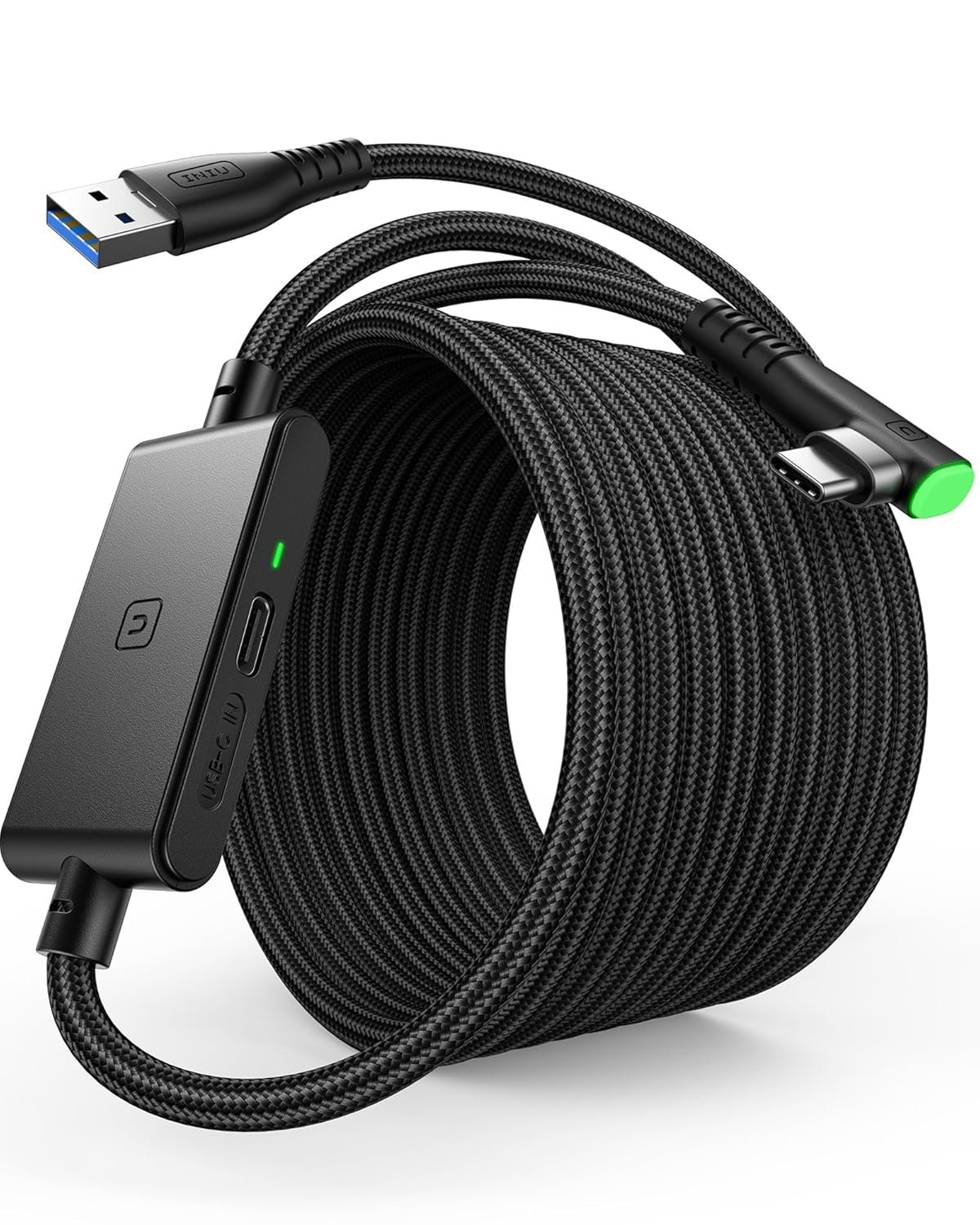
INIU’s VR Link Cable with Separate Charging Port distinguishes itself from typical USB tether cables through a design that isolates data transfer from power delivery, letting Meta Quest, Oculus, and Pico headset owners charge during extended play sessions without competing for bandwidth on a single line. Virtual reality headsets tethered to a PC or streaming box depend heavily on cable choice: a poorly shielded or overly rigid cord can introduce dropped frames, tracking stutter, or physical strain during longer sessions, while an underpowered charging path can leave a headset draining faster than it charges. The INIU DI401 link cable pairs a 16-foot, FLYWEAVE-coated jacket with a USB 3.0 data architecture rated for 2.5 gigabits per second, a 90-degree hooked USB-C connector rated past 45,000 bend cycles, and a separate charging channel governed by a SmartProtect2.0 chip. It is built for buyers who already own a compatible standalone VR headset, such as the Meta Quest 3, Quest 3s, Quest 2, or Quest Pro, or a Pico 4 series device, and who plan to use it for PC VR or Steam VR streaming rather than as a general-purpose phone or laptop charger. The sections that follow break down charging behavior, data throughput, physical comfort, compatibility, and build quality relevant to that use case.
Quick Overview
| Feature | Details |
|---|---|
| Device Category | USB VR link cable with separate data and charging paths |
| Brand / Model | INIU / DI401 (DI-401) |
| Cable Length | 16 feet (5 meters) |
| Connector Type | USB-A to USB-C, male-to-male, 9-pin, 90-degree hooked USB-C end |
| Data Transfer Rate | Up to 2.5 Gbps (USB 3.0 architecture) |
| Charging Specs | Separate USB-C charging port, up to 3.1A / 9V / roughly 18W with a PD/QC adapter |
| Charge Management | SmartProtect2.0 chip regulates current, targets a safe charge range around 78 percent |
| Durability Rating | FLYWEAVE braided coating; connector rated past 45,000 bend cycles |
| Compatible Devices | Meta Quest 3s, Quest 3, Quest 2, Quest 1, Quest Pro; Pico 4, Pico 4 Pro, Pico 4 Enterprise; PC VR / Steam VR |
| Weight | 0.25 kilograms (about 8.8 ounces) |
| Certification | UL-listed components |
| Warranty | 3-year INIU Care product warranty and technical support |
These specifications position the cable as a dedicated accessory for tethered VR sessions rather than a general charging cable. The separated charging path and 2.5 Gbps data ceiling matter most to users who run PC VR titles for extended periods and want to avoid a headset losing charge mid-session. The 16-foot length and reinforced jacket suit players with room-scale play areas, while the 3-year support window signals sustained daily use rather than occasional plug-in sessions.

Charging Performance and Power Delivery
Charging behavior is the feature INIU emphasizes most in this cable’s design, and it centers on separating the charging line from the data line rather than routing both through a single USB-C connection as many bundled headset cables do. The dedicated charging port supports up to 3.1 amps at 9 volts, translating to roughly 18 watts when paired with a compatible PD or QC fast-charging adapter, though the cable itself ships without one. This matters for PC VR users who run graphically demanding titles for an hour or more, since Quest and Pico headsets under sustained load can drain faster than a standard low-wattage charger replenishes them. A separate charging path avoids the bandwidth contention that can occur when charging and data sync share a single line, a common complaint associated with generic single-port link cables.

Separate USB-C Charging Port and 3A Power Delivery
The charging port operates independently from the USB-A/USB-C data line, drawing power directly rather than passing it through the same controller handling video and tracking data. At 3.1 amps and roughly 18 watts of maximum draw, it is rated to outpace the battery drain many current-generation standalone headsets experience during PC VR streaming, provided the adapter supplying that port itself supports PD or QC fast-charging protocols.
Buyers should note the cable includes no charging brick in the box, so the stated 3A ceiling is only reachable with a separately purchased adapter capable of matching that output. A standard 5W phone charger connected to this port will still charge the headset, but noticeably slower than the cable’s rated maximum.
SmartProtect2.0 and Battery-Conscious Charging
INIU’s SmartProtect2.0 chip governs current flow through the charging line, which the manufacturer states keeps the headset’s battery within a safe operating range around 78 percent during sustained charge-while-play sessions. This kind of current regulation is a common approach among third-party charging accessories aiming to reduce heat buildup and the long-term battery degradation that can result from constant top-up charging during multi-hour gaming sessions.
For users who primarily play in short bursts, this charge-limiting behavior is largely invisible. For those who tether their headset for extended streaming or development work, it functions as a background safeguard against the battery stress associated with holding a lithium battery near full charge for hours at a time.
Data Transfer Speed and Signal Reliability
Data throughput is handled by a USB 3.0 architecture with a 9-pin connector layout, rated for transfer speeds up to 2.5 gigabits per second. That figure sits below top-tier USB 3.2 link cables but remains sufficient for the video and tracking data most PC VR titles require when streaming from a desktop or laptop GPU. The product specifications note that cable length can slightly affect transfer speed, a known characteristic of long-run USB cables generally, since electrical resistance and signal degradation increase over distance regardless of manufacturer. Buyers running the most graphically intensive PC VR titles at maximum resolution and refresh rate may notice more headroom with a shorter or higher-bandwidth alternative, while typical Quest Link or Pico streaming use cases fall comfortably within this cable’s rated capacity.

USB 3.0 Architecture and 2.5 Gbps Throughput
The 2.5 Gbps rating reflects a mid-tier USB 3.0 implementation rather than the higher-bandwidth USB 3.2 Gen 2 standard some link cables advertise. In practical terms, this ceiling accommodates compressed VR video streams and positional tracking data for most current headset software, since Quest Link and Air Link-style encoding already compress the video signal before it reaches the cable.
Users pushing very high-resolution PC VR content at elevated bitrates are the segment most likely to notice the difference between this rating and a higher-spec alternative, though for the majority of Quest and Pico streaming setups the gap is unlikely to be perceptible during normal gameplay.
Signal Consistency Over a 16-Foot Run
Length is a factor in any USB data cable, and a 16-foot run is long relative to the 6-to-10-foot cables bundled with most headsets. INIU’s own product notes acknowledge that cable length slightly affects transfer speed, an admission that aligns with standard USB signal behavior rather than a defect specific to this product.
Shielding quality inside the FLYWEAVE jacket influences how much of that theoretical speed loss is realized in practice. Users in play areas with significant electromagnetic interference from routers, monitors, or other electronics may see more inconsistency than those in cleaner signal environments.
Cable Length, Comfort, and Freedom of Movement
Physical comfort during VR sessions depends heavily on how a tether cable behaves in motion, and INIU’s 16-foot length is built specifically to extend a play area beyond what a headset’s stock cable typically allows. Room-scale games that involve turning, crouching, or lateral movement benefit from extra slack that keeps the cable from pulling taut or snagging underfoot mid-session. The FLYWEAVE braided coating adds a layer of abrasion resistance compared to a smooth PVC jacket, which matters most for cables that regularly drag across carpet, furniture, or hardwood flooring during active gameplay. At 0.25 kilograms for the full 16-foot length, the cable carries noticeably more mass than a standard headset cable, a tradeoff most long-cable designs accept in exchange for extended reach and reinforced durability.

Living Room and Play-Space Considerations
A 16-foot cable is intended for users with a defined room-scale play space, typically a cleared area of a living room or dedicated game room, rather than a small desk setup where a shorter cable would suffice. The extra length allows the PC or console end to sit farther from the play area, reducing the chance of tripping over hardware positioned too close to an active movement zone.
Users with compact spaces or those who primarily play seated may find 16 feet more cable than necessary, adding bulk and potential tangling risk without a corresponding benefit in freedom of movement.
Weight, Flexibility, and Everyday Handling
The braided FLYWEAVE exterior is stiffer than a bare rubber cable, which helps it resist kinking but also means it holds its shape less like a flexible cord and more like a structured cable run. Combined with the 90-degree hooked connector and included sticky securing buckle, the design leans toward a fixed, semi-permanent installation rather than a cable meant to be coiled and packed away after every session.
Users who frequently travel with their headset or set up and break down their play space daily may find the length and stiffness less convenient than a shorter, more pliable cable suited to portability.
Headset and Platform Compatibility
Compatibility spans two major standalone VR ecosystems and one PC-based streaming path, covering Meta’s Quest lineup (Quest 1, Quest 2, Quest 3, Quest 3s, and Quest Pro), the Pico 4 series (Pico 4, Pico 4 Pro, and Pico 4 Enterprise), and general PC VR setups running through Steam VR. This breadth matters because link cables are frequently headset-specific in connector orientation and power handling, and a cable rated across this many device generations reduces the risk of buyers needing a different cable after a headset upgrade. The male-to-male USB-A to USB-C configuration assumes a USB-A port is available on the PC or laptop side, which is a consideration for buyers with newer, USB-C-only computers who may need an adapter or hub to complete the connection.

Meta Quest and Oculus Support
Coverage across the entire Quest family, from the original Quest through the Quest 3s and Quest Pro, gives the cable a longer useful life than accessories tied to a single headset generation. This is particularly relevant for households or shared setups where multiple Quest models might be used interchangeably with the same cable.
Meta’s own Quest Link software handles the PC VR streaming pipeline once the cable is connected, so cable compatibility here is limited to physical connection and data throughput rather than any software-level pairing requirement.
Pico 4 and PC VR Steam VR Compatibility
Pico 4, Pico 4 Pro, and Pico 4 Enterprise support extends the cable’s usefulness beyond the Meta ecosystem, which is relevant given Pico’s expanding footprint in enterprise and consumer VR markets. Steam VR compatibility further broadens the cable’s applicability to PC VR headsets and setups that rely on SteamVR’s tracking and rendering pipeline rather than a headset manufacturer’s proprietary software.
Buyers should still confirm their specific PC has a free USB-A 3.0 port capable of sustaining the cable’s rated 2.5 Gbps throughput, since an older or lower-spec USB port can bottleneck performance regardless of cable quality.
Build Quality and Durability
Durability claims center on two components: the FLYWEAVE outer coating that wraps the cable’s full 16-foot length, and the 90-degree USB-C connector INIU states has passed more than 45,000 bend-cycle tests. Braided coatings like FLYWEAVE are a common durability upgrade over bare PVC insulation, offering better resistance to fraying, pet chewing, and abrasion from repeated dragging across floors during active play. The connector’s bend rating and hooked 90-degree design work together to reduce strain at the point where the cable meets the headset, a common failure point on cables that use a straight connector unsupported during lateral movement. A sticky buckle accessory is included to anchor the cable at a fixed point, further reducing repetitive stress on the connector during gameplay that involves turning or pacing.

FLYWEAVE Coating and Bend-Test Rated Connector
The FLYWEAVE jacket functions similarly to braided cabling found in other durable USB accessories, prioritizing tensile strength and abrasion resistance over the flexibility of a bare rubber cord. This tradeoff generally extends usable lifespan in high-friction environments, such as carpeted play areas or spaces shared with pets, at the cost of a slightly stiffer handling feel.
The 45,000-plus bend-cycle rating on the connector addresses a specific and common failure mode in VR link cables, where repeated flexing at the headset connection point causes internal wire fatigue over months of regular use.
Warranty Coverage and Long-Term Support
INIU backs the DI401 with a 3-year product warranty and ongoing technical support, a notably longer coverage window than the 1-year terms common among generic third-party cable brands. This length of warranty suggests a degree of manufacturer confidence in the cable’s internal components and connector durability under continued use.
For buyers evaluating cables as a long-term VR accessory rather than a disposable one, extended warranty coverage reduces the practical risk of investing in a longer, reinforced cable that costs more upfront than a basic stock replacement.
Pros & Cons
Pros
- Separate USB-C charging port avoids bandwidth competition between data sync and power delivery, letting the headset charge and stream simultaneously without one function throttling the other.
- Charging capacity up to 3.1A and roughly 18W with a compatible PD/QC adapter supports faster replenishment during extended PC VR sessions than a standard headset charger typically provides.
- SmartProtect2.0 current regulation targets a conservative charge ceiling, which may reduce the battery stress associated with holding a lithium cell near full charge for hours at a time.
- A 16-foot/5-meter length accommodates room-scale play areas that a headset’s stock 6-to-10-foot cable cannot comfortably reach.
- FLYWEAVE braided coating adds abrasion resistance for cables that regularly contact flooring or furniture during active movement-based gameplay.
- A 90-degree hooked connector rated past 45,000 bend cycles targets a common failure point where cables meet the headset port.
- Broad compatibility across Quest 1 through Quest 3s and Quest Pro, plus the Pico 4 lineup and PC VR Steam VR setups, reduces the likelihood of needing a replacement cable after a headset upgrade.
- A 3-year warranty and manufacturer technical support extend beyond the coverage typical of budget link cables.
Cons
- No charging adapter is included, so reaching the cable’s rated 3A/18W charging speed requires a separately purchased PD or QC fast charger.
- The rated 2.5 Gbps data ceiling falls short of higher-end USB 3.2 link cables, which may matter to users running the most demanding PC VR titles at maximum settings.
- The FLYWEAVE jacket and 90-degree connector produce a stiffer, more structured cable that is less convenient to coil and store than a lighter, more flexible alternative.
- A male-to-male USB-A to USB-C design requires a USB-A port on the PC side, which some newer USB-C-only laptops lack without an additional adapter.
- At 0.25 kilograms over 16 feet, the added weight and length may be more cable than necessary for users with small or seated play spaces.
Final Verdict: Who This Wearable Is Best For (and Who Should Skip It)
The INIU DI401 VR Link Cable is best suited to owners of Meta Quest 3, Quest 3s, Quest 2, Quest Pro, or Pico 4-series headsets who regularly run PC VR or Steam VR sessions lasting an hour or longer and want a physically separated data and charging path rather than a single shared USB-C connection. Its 16-foot length particularly favors users with a dedicated room-scale play area, while the SmartProtect2.0 charge management and 3-year warranty suit buyers planning to use the cable as a long-term daily accessory rather than an occasional backup. Households running multiple headset generations also benefit from the cable’s broad cross-compatibility, avoiding the need for a separate cable per device.
Buyers who primarily play seated at a desk, use a headset in a small space where 16 feet of cable is unnecessary bulk, or want a single cable to charge phones and other devices alongside their headset are likely better served by a shorter, more general-purpose USB-C cable. Those chasing the highest possible PC VR data throughput at maximum settings may also want to compare the 2.5 Gbps rating against higher-bandwidth USB 3.2 alternatives before committing. Within its intended niche of extended, tethered VR sessions in a fixed play space, the cable’s separated charging design and reinforced connector address specific pain points common to standard headset cables in the 2026 PC VR accessory market.
Frequently Asked Questions (FAQs)
Does the INIU VR Link Cable charge a Meta Quest headset while it is being used for PC VR streaming?
Yes, the cable is designed to allow charging and data transfer simultaneously because it routes power through a separate USB-C charging port rather than sharing bandwidth with the data line. This design targets extended PC VR sessions where headset battery drain is common. Actual charging speed still depends on the adapter connected to that port, since the cable itself does not include a charging brick capable of reaching its full rated output.
What data transfer speed does the INIU VR Link Cable support?
The cable uses a USB 3.0 architecture with a 9-pin connector layout rated for data transfer speeds up to 2.5 gigabits per second. This is sufficient for most Quest Link and Pico streaming setups, though it sits below higher-end USB 3.2 cables. INIU notes that cable length can slightly reduce realized transfer speed, which is typical behavior for long-run USB cables rather than a defect.
Is the INIU VR Link Cable compatible with Pico 4 headsets?
Yes, the cable is listed as compatible with the Pico 4, Pico 4 Pro, and Pico 4 Enterprise headsets in addition to the full Meta Quest lineup and PC VR setups running Steam VR. This cross-platform compatibility makes it usable across multiple headset ecosystems without needing a different cable for each device, provided the connecting PC has an available USB-A port.
Can this cable be used to charge a phone or tablet?
No, INIU specifically states this cable is designed as a VR link cable and should not be used to charge phones, tablets, or laptops. Its charging port and current regulation are calibrated specifically for VR headset battery behavior rather than general mobile device charging profiles, and using it outside that intended purpose is not something the manufacturer supports, tests for, or recommends for everyday consumer electronics charging needs.
Does the INIU VR Link Cable come with a charging adapter?
No, the package includes only the 16-foot USB link cable, a quick start guide, and a user manual, with no charging brick or wall adapter provided. Reaching the cable’s rated 3.1A and roughly 18-watt charging ceiling requires a separately purchased PD or QC fast-charging adapter, since a standard low-wattage phone charger will still function but deliver a noticeably slower charging rate to the headset.
How long is the INIU VR Link Cable and does the length affect performance?
The cable measures 16 feet, or approximately 5 meters, considerably longer than the 6-to-10-foot stock cables bundled with most VR headsets. Longer USB cables can experience minor signal and speed reduction compared to shorter cables, a characteristic INIU itself acknowledges in its product notes, though the cable remains officially rated for its full 2.5 Gbps data ceiling under typical indoor operating conditions and setups.
What is SmartProtect2.0 and how does it affect battery health?
SmartProtect2.0 is INIU’s charge management chip built into the cable’s charging line, designed to regulate current flow and keep the connected headset’s battery within a safe operating range, reportedly around 78 percent, during sustained charge-while-play use. This approach aims to reduce the heat buildup and long-term battery stress associated with holding a lithium-based device near full charge for extended, multi-hour charging sessions.
What warranty coverage does the INIU VR Link Cable include?
The cable is backed by a 3-year INIU Care product warranty along with ongoing manufacturer technical support, exceeding the 1-year coverage typical of many third-party VR accessory cables sold in the same category. This extended warranty period is generally intended to reflect manufacturer confidence in the long-term durability of the cable’s connectors, braided jacket, and internal wiring under regular, repeated daily use.